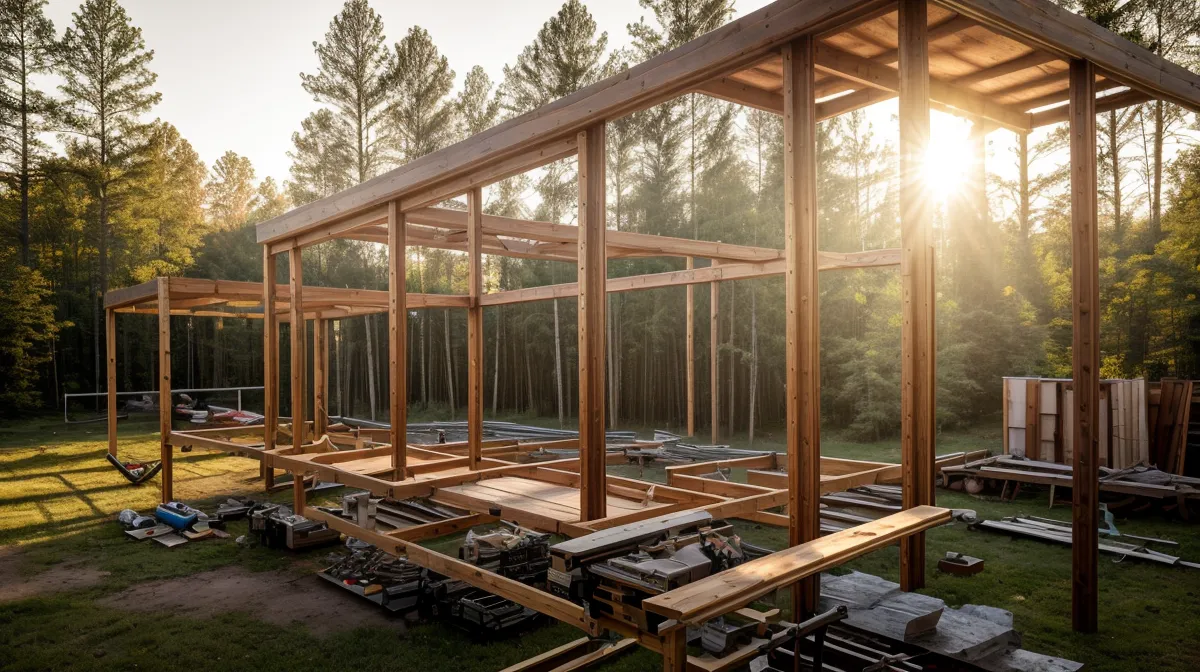
Ten percent of every lumber order we place is wood we've already written off before a single board gets cut. That's not bad luck and it's not a typo; it's the line item most backyard builders forget to put in the budget at all, and it's the difference between a lumber run that stays on track and one that blows up the whole outdoor construction plan halfway through. We didn't invent that number. We earned it, one rural North Carolina project at a time, on a half-acre lot where the shed, the chicken coop, and a workshop that is STILL not finished each found a new way to prove that lumber budgeting is almost never about the lumber itself.
The Myth That Nearly Wrecked Our Workshop Budget
Here's the myth we both believed when we started: the lumber yard receipt is the budget. Add up the board feet, multiply by the price, done. It isn't done. That total covers less of the real cost than most people assume, and the rest hides in places you don't think to look until you're standing in the driveway with a truck that's somehow still not full enough.
The sticker price only covers the boards. The real number adds in the waste you'll create no matter how careful your cut list is, the fasteners and hardware that always cost more than you remembered, and whatever that specific project throws at you that has nothing to do with wood at all. It's the same reason a recipe calls for a little more flour than the dough actually needs — you won't use all of it, but running out halfway through mixing is worse than having extra left in the bag.
Why Cheap Lumber Is the Most Expensive Lumber
This one still stings a little. Early on, we grabbed the cheapest pressure-treated four-by-fours we could find at the big box store for a project that didn't seem to deserve anything fancier — fence posts, nothing load-bearing, why pay extra? Within a single season, every one of them had warped into something closer to a banana than a post. Not bowed a little. Bowed enough that you could see daylight under a string line stretched between two of them. We pulled all of them, ate the cost of doing the job twice, and learned the actual rule: price per board is not the same thing as price per project. A post that needs replacing within a year was never actually the cheap option, no matter what it rang up as at checkout.
Grade matters more than the sticker, and so does something most people never think about until they're standing in the aisle doing math — a two-by-four at the store never actually measures two inches by four, and that gap between the nominal size and the real size quietly throws off your plans if you don't account for it. That's really a topic on its own, so we won't try to cram the whole thing in here. Buying smarter also means buying less gear than you think you need; the tools we actually reach for on every build turned out to be a much shorter list than the one we started with, and that shorter list is its own kind of savings.
What a Home Depot Run in Apex Teaches
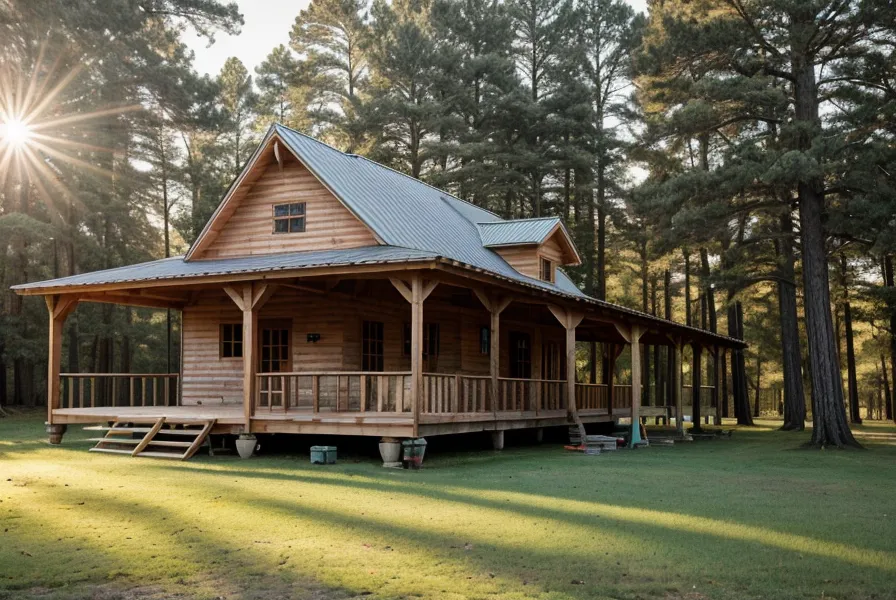
Pick almost any Saturday and you'll find one of us in the lumber aisle at the Home Depot in Apex, running numbers on a phone calculator because the cut list says one thing and the stack of boards in front of us says another. That's where the real budgeting happens — not at the kitchen table the night before. Stand there long enough and you start noticing which stacks have been picked over, which boards are still wet from treatment, and which ones have sat long enough to actually be straight. None of that shows up on a price tag.
There's also a persistent idea floating around that buying lumber in the dead of winter saves money because demand drops. In our experience that's backwards. A quiet season means a store can mark things up with nobody around to notice or shop the competition. The better window tends to show up when inventory is turning over fast and a yard wants the stacks clear for the next truck, not when nobody's buying wood at all.
A couple of the biggest budget leaks aren't material costs at all — they're time costs that turn into material costs later. Skipping a level and square check before locking a post in place is the fastest way to turn one redone footing into two. Starting a project from an actual set of plans instead of improvising as you go is probably the single biggest lumber-saving habit we've picked up, because wood bought to fix a mistake is wood you paid for twice.
Every Backyard Project Hides Its Own Line Item
Framing a wall for the workshop ate through more studs than our early estimate ever accounted for, once you add the extra pieces around a doorway and a window that a simple square-footage guess never includes. Roof pitch on anything with a roof — shed, lean-to, coop — changes how much material it takes to shed water properly, which changes the materials list all over again. Outdoor furniture has its own quiet trap: wood expands and contracts with the seasons, and a piece built without room for that movement eventually splits along a seam no matter how well it was built. Diagonal bracing against a frame racking sideways costs next to nothing compared to fixing a gate or a wall that's already leaning. Treated lumber for anything touching the ground also costs more than the untreated stuff stacked right next to it, which is a budgeting decision as much as a technical one. Step into the world of pressure-treated wood and most of what you'll find today is treated with something like alkaline copper quaternary, if you ever want to check the label — the full story of treated versus untreated is a post of its own.
Sitework changes the math just as much. Footings for the shed, and for the half-acre layout we mapped around the workshop, have to go down to the right depth for our Piedmont clay, and that's concrete and labor before a single stud goes up — and the concrete itself has its own quirk, since the mix and cure time decide when you can actually build on top of it, so rushing that step to save a weekend costs you somewhere else entirely. A raised deck brings its own surprise: cross a certain size or height and you're suddenly filling out permit paperwork instead of just buying boards. Decide whether that deck stands on its own or ties into the house and the whole materials list changes again. A pergola's budget lives or dies by how far apart the posts land, because that spacing decides how big — and how expensive — the beam across the top has to be. Even grading and drainage around a structure, work that has nothing to do with a stud or a joist, can quietly become its own line before you've bought a single two-by-four.
Fasteners deserve a line of their own, too. The bargain box of screws by the register is never the right call for anything outdoors — corrosion-resistant fasteners cost more up front and save you a repair bill later that costs far more than the difference ever did. A chicken coop's hardware, the predator-proof latches and the right gauge of wire mesh, can genuinely cost more than the lumber framing it, which surprises almost everyone the first time they actually price it out. A reader named Wanda emailed us after that coop post went up, asking whether the A-frame design would hold through an ice storm in her county. She ended up building something completely different for her own flock, but she still tells us that post is what finally got her off the fence about starting at all — proof that a plan doesn't have to survive contact with your actual yard to be worth writing down in the first place. Anything built near a fire pit needs materials rated to handle heat, and those aren't priced like ordinary decking. Once a project is actually finished, exterior wood needs sealing on a schedule, which is a cost that shows up in year two, not on the original receipt — a lot of backyard budgets quietly fall apart right there, the year after the build, not during it.
None of this even touches anything that needs power or water, and those projects live on a different budget planet entirely. Wiring landscape lighting means thinking about how far the wire runs before voltage drop makes the last fixture dimmer than the first, which has nothing to do with board feet. Sizing a small off-grid solar setup for an outbuilding is its own puzzle, and it has to get solved before you frame a single wall around it. A rainwater collection system cares about how much pressure gravity gives you based on tank height, not about lumber in any way. Even a simple cold frame for stretching the growing season lives or dies by its venting hardware, which can cost more relative to the build than the wood frame holding it together does. None of it is a lumber cost. All of it shows up in the same backyard build budget, and none of it shows up on a lumber yard receipt.
Budgeting Like You Mean It
Our scrap pile tells the real story better than any spreadsheet does. It used to spill out from beside the workshop under its tarp, a jumble of odd lengths left over from every build we hadn't planned tightly enough. These days, after the shed, the coop, the deck, and the pergola, it barely covers a corner — not because we're buying less wood, but because almost none of it goes to waste anymore. Patrice showed up for a work weekend not long ago with a cooler packed like she was feeding twice the crew we actually had, took one look at how small that pile had gotten, and asked if we'd finally gotten boring. Fair question. Boring, in this case, is the whole point — the smaller the pile, the better the math worked out. Most of what's left eventually finds a second life anyway; the leftover four-by-fours from one waste-buffer order are the reason we built a DIY wood hammock stand instead of buying a flimsy one.
So here's the correction, plain and simple: stop budgeting for lumber and start budgeting for the project. Price the boards, sure, but then price the waste you're going to create, the fasteners nobody remembers until the register, and whatever that specific build throws at you that has nothing to do with wood — concrete, permits, hardware, wiring, drainage. Add all of it up before you ever pull into the lot, and the number you land on will actually survive contact with the build. That's the only budgeting rule that's ever held up for us, project after project, with the bank account still standing at the end of it.