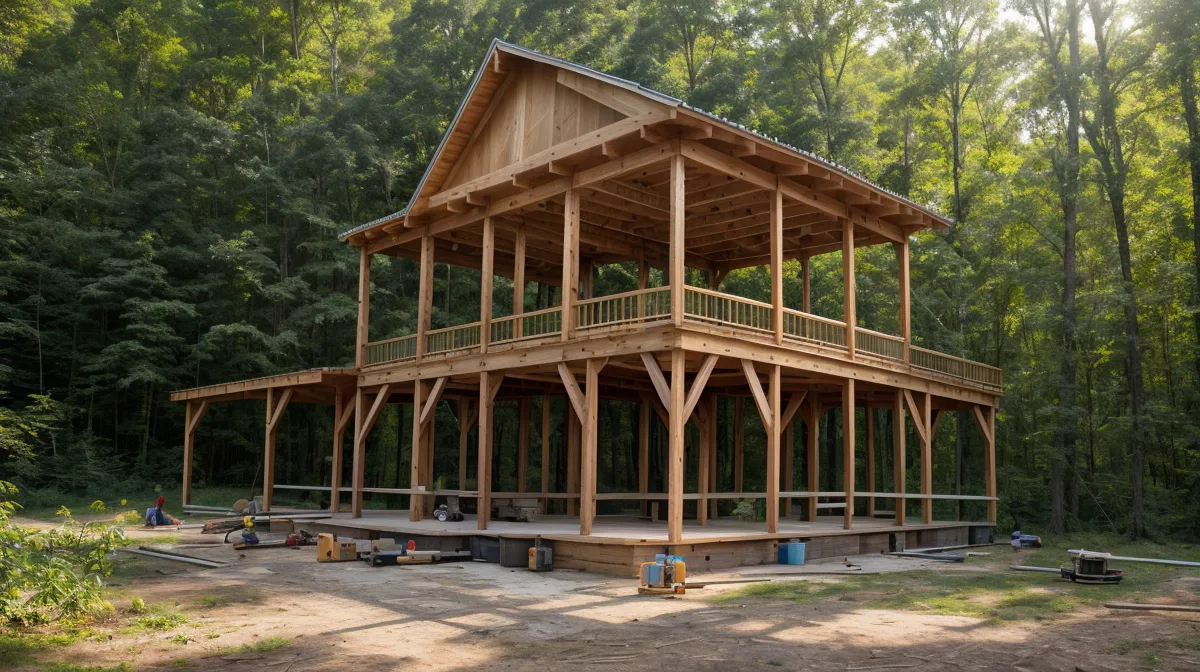
A speed square has outlasted every battery-powered gadget we have brought home for backyard construction on this rural half-acre lot. That is the short version of this whole outdoor building comparison, and we will spend the rest of it proving why. We are a couple who bought a fixer-upper in rural North Carolina, decided a contractor for every project would bankrupt us faster than the mortgage, and five years into doing our own DIY tool shopping, the gadgets that promised to make building easier are mostly dead weight on a shelf while five plain tools do nearly all the work.
Here is the pattern we keep running into. Every time we start a new project — the shed, the coop, the deck, the pergola, the workshop that is still, somehow, not finished — a shiny tool shows up promising to replace skill with electronics. Sometimes it does. More often it just adds a battery we have to remember to charge. Outdoor building does not reward complexity. It rewards whatever survives red clay, humidity, and two people who are still, five years on, not great at measuring anything correctly the first time.
The Speed Square vs. the Laser Guide That Never Left Its Case
Our first project was a simple storage shed, and we went into it assuming we needed specialty clamps and a laser-guided cutting jig to make up for not being real builders. The clamps turned out to be useless on lumber that had already bowed from sitting in the humidity — nothing holds a 90-degree angle on a board that is not actually straight. The laser jig lasted about three days before it stopped calibrating in direct sun, and from then on it sat in its case while we went back to a hammer, a chalk line, and a speed square — technically known as a rafter square.
A speed square is not just for drawing lines. It is a built-in saw guide — press the fence against the board, run the saw plate along the edge, and you get a straight cut without batteries or recalibrating anything. We also started working off an actual cut list instead of guessing board by board, which is its own separate habit worth building, but that is a story for another day. We did learn, the hard way, that a tape measure lies a little: a "two by four" is never quite two inches by four inches once it is milled, and that gap is enough to throw off a corner if you are not paying attention.
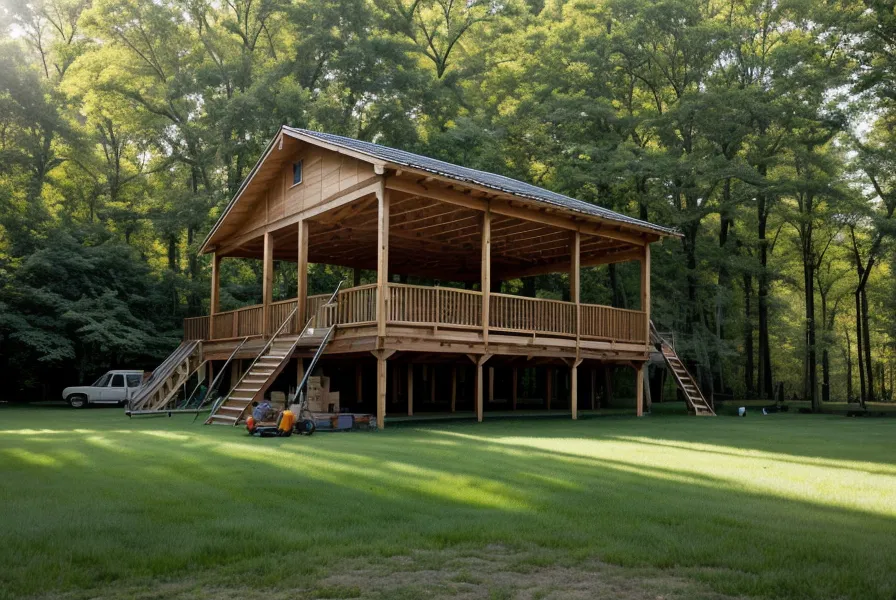
Fasteners turned into their own lesson that summer. Pressure-treated lumber survives the damp Carolina ground, but it is not friendly to just any screw — regular steel corrodes fast against treated wood, so we switched to coated or stainless fasteners for anything touching dirt and stopped thinking about it. That is a deeper rabbit hole than this piece has room for, and honestly, the standard ratings for ground-contact lumber are worth their own read before you buy a single board.
Why the Impact Driver Earned a Permanent Spot in the Tool Bag
By the time we started the pergola and the workshop framing, the 18V impact driver had become the one tool neither of us would hand over. Driving three-inch deck screws with a regular drill-driver means leaning your whole body weight into the bit just to keep it from slipping — the impact driver hammers as it rotates, so you are guiding it instead of wrestling it. We still remember a screw skating sideways off a cinderblock footer and disappearing somewhere under the workbench, never to be found again, which tells you something about how often the bit used to slip before we switched.
Not every shortcut worked out, though. Early in that framing stretch we tried gluing a corner joint with construction adhesive alone, skipping the extra screws because the bond looked solid going in. A stretch of cold weather that spring proved otherwise — the joint let go clean, and we rebuilt it with actual structural screws backing up the glue instead of trusting adhesive to do a screw's job.
Corded or Cordless: Which Saw Actually Finishes the Job?
Here is the trade-off nobody mentions at the tool aisle: cordless is wonderful for anything you carry up a ladder or across the yard, and nearly useless the moment you need sustained torque on wet, pressure-treated lumber for an hour straight. We eventually bought a corded circular saw for the heavier workshop framing, and it did not bog down the way our battery saw did on thick joists — it also never left us sitting on a pile of wood waiting for a charger to blink green.
Neither wins all the time. If you are building something stationary for more than an hour — a deck frame, a workshop wall — run the extension cord, because you will have one out anyway for a radio or a charger. If you are up on a ladder, on a roof, or moving across a half-acre lot between tasks, cordless wins every time and the extra weight of a battery is worth it. We weighed this exact trade-off when we were deciding when to build it yourself and when to call a contractor, because the right saw can turn a job that feels like it needs a pro into something two stubborn people can finish themselves.
The Digital Level That Lied to Us
We bought a digital level that beeps when something is plumb, and for a while we trusted it completely. Then one afternoon, framing a wall in the workshop, we stepped back and found a gap where two sections did not line up — the digital sensor had gotten knocked out of true in the heat weeks earlier, and we had been building "level" against a reading that was quietly wrong the whole time.
That kind of level — a yellow liquid vial with no calibration to lose — earned its place back immediately once we dug it out of the truck. Checking square, level, and plumb by eye and by bubble on every stud is slower than trusting a beep, but it is the one habit from that framing stretch we would NOT trade back. We kept the studs at a standard spacing while we were at it, mostly because every tape measure already has a mark there, and reinventing that wheel would have cost more time than it saved.
What Actually Earns Its Keep in Backyard Construction
Strip away the brand names and the "smart" features, and the tools doing the real work on our half-acre lot are almost embarrassingly plain. The speed square earns its spot on every cut. The chalk line is what actually keeps a deck edge or a foundation line straight, not a laser that drifts in the sun. The impact driver replaced the drill-driver for anything longer than an inch and a half. A corded saw handles the stationary, high-torque jobs that drain a battery pack in under an hour. A tape measure with a long enough standout lets one person measure a wall alone, which matters more than it sounds like it should when your building partner is elbow-deep in something else. That is NOT a complete kit — a reader chasing a full list of what belongs in a basic outdoor setup has other places to look for that — but it is the short list that actually got used, repeatedly, on every structure we have built so far.
Choosing Between the Gadget and the Basic Tool
Our rule, five years into doing this ourselves, comes down to one question: does this tool do its job without a battery, an app, or a calibration step? If yes, buy the gadget version anyway if it saves your back — nobody hands out awards for doing things the hard way. If the answer is no, and the tool's whole pitch rests on electronics doing what a steady hand and a bubble vial already do, skip it. A laser level might earn its keep inside a finished room where the light is even and nothing is bowed. Out in red clay and full sun, buy the plain speed square and the box level instead, because that is where the electronics fail first and the plain tools just keep working.
There is a particular feeling when the last board of a run finally goes up and sits flush against its neighbor with no shim and no second cut — that moment is worth more than anything with a battery indicator. We would rather spend a Saturday afternoon on the trails at Haw River State Park than stand in the workshop fighting a jig that will not hold calibration, and increasingly, that is the choice the right tools let us make. A neighbor down the road who spends his weekends restoring old motorcycles in a cinderblock garage told us once that the tools he trusts most are the ones that do not need him to trust them at all. Out here, building sheds and decks instead of engines, we have landed on the same answer.