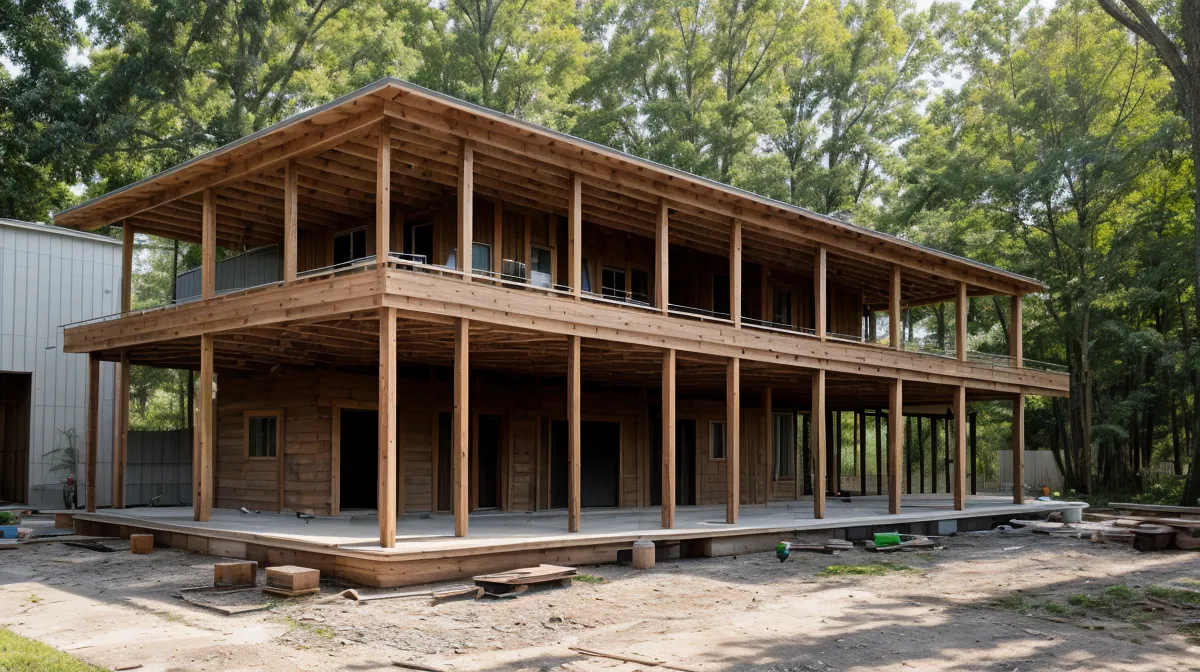
We had to choose between spending a full Saturday feeding eighty-pound bags of concrete into a rented mixer, or trusting a stranger with a ten-yard truck to fill your entire shed foundation in one pour. We didn't have an answer either, and honestly, that question is what most of our first real concrete project came down to. Every backyard construction guide we found assumed you'd already picked a lane. We hadn't. Our half-acre of rural Chatham County red clay did not care that we were still arguing about it.
Saturday mornings usually mean the Pittsboro Farmers Market in Chatham County for us. This one got traded for a truckload of lumber, forty-five bags of concrete mix, and a rented electric mixer that sounded like a drum kit stuffed inside a dryer. Neither of us had ever poured anything bigger than a fence-post footing, so we'd spent the whole week before arguing about whether bagged concrete or a ready-mix delivery truck made more sense for a shed the size of ours.
Two Ways to Pour a Backyard Shed Foundation
Bagged concrete means total control and a sore back: you mix it in small batches, pour it fast, and you're the only one responsible if it goes sideways. A ready-mix truck means someone else does the heavy lifting, literally, but you're locked into their schedule and their minimum load, whether your slab actually needs that much concrete or not. We'd already found out, pricing out a differently sized slab for another project, that plenty of counties don't require a permit until you cross a certain footprint — ours didn't, but it was worth the twenty minutes on the county website to be sure.
Our slab is freestanding, sitting past the fence line rather than tied to the house, which gave us more flexibility on exactly where it landed relative to the property line than a house addition would have had. It also meant we didn't need the deep frost footings a load-bearing addition requires — a floating slab just needs to be flat, well-supported, and able to move a little with the ground instead of fighting it. The clay under our lot holds onto water like a bad idea holds a grudge, so grading the yard away from where the slab would sit mattered more than either of us expected, even though drainage on this half-acre is really its own separate headache.

Setting Forms Without Losing an Afternoon
She had the footprint sketched on graph paper before we bought a single bag, which is more planning than some of our earlier builds ever got, and we've since learned the hard way that skipping the plans entirely just costs you twice. Getting a form square, level, and plumb before you pour is its own skill, one we're still sharpening on every project, but for a slab this size it mostly meant patience and a lot of rechecking. Standard 2x4 form lumber is never actually two inches by four inches either, something every DIYer eventually gets bitten by when they're calculating slab depth down to a fraction of an inch. Behind us, a stack of pressure-treated boards staged for another project baked in the July sun, throwing off that sharp vinegar-and-pine smell that means lumber season has officially started.
I set the four-foot level across the top of the far form board without much hope, and for once the bubble floated dead center — no shims, no swearing, no do-over. That kind of luck didn't carry over to everything, though. We'd already learned, on an earlier build, exactly what happens when you trust construction adhesive to do a structural screw's job: a joint held together with glue alone looked fine all winter and then pulled apart the first warm week of spring. Whatever hardware ends up near this slab has to shrug off North Carolina humidity for years, and that's a lesson we've already paid for once with fasteners that weren't built for outdoor life, so we braced those forms with actual screws and did not skimp.
What Mixing Forty-Five Bags Yourself Actually Costs You
Mixing bagged concrete by hand is a repetitive, exhausting rhythm: water, bag, spin, pour, repeat forty-five times. Every eighty-pound bag hoisted over the edge of that spinning drum landed somewhere in my spine. Concrete doesn't just dry, either. It goes through a chemical reaction called hydration that generates its own heat, and when that meets a ninety-five-degree North Carolina afternoon, the mix starts setting up faster than you can work it. Nobody warns you about the gritty grey dust sticking to sweaty forearms or the alkaline smell of wet cement that stays in your nose for days.
We hit a genuine panic point when the front half of the slab started stiffening while we were still pouring the back half. Both of us ended up on our knees with a spare 2x4 as a screed board, sawing it back and forth across the forms, shouting over the mixer, racing a clock neither of us could see. Then came the sinking feeling: three bags short, with wet concrete already curing in the forms and no time to spare. One of us stayed behind smoothing the surface while the other made a mud-caked drive for more bags, praying the store had the same mix in stock.
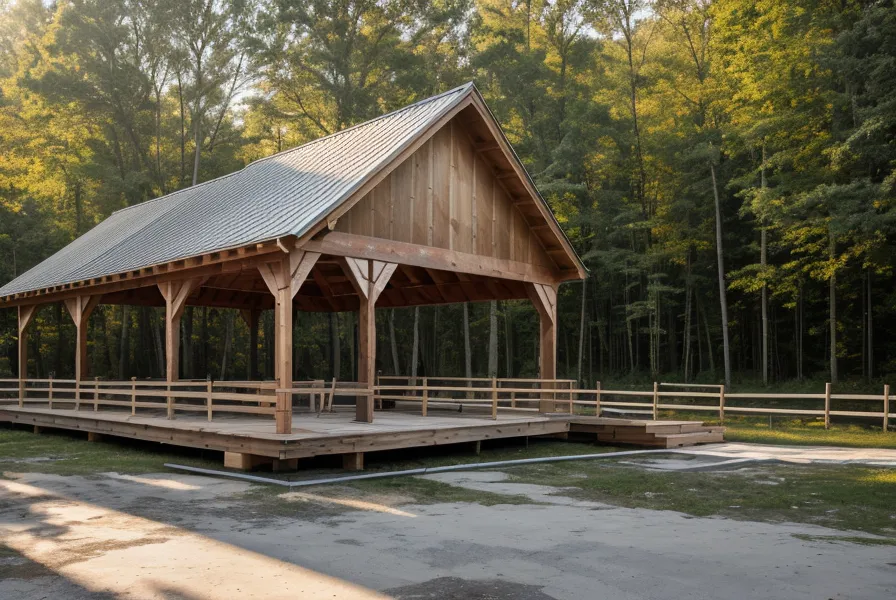
Would a Ready-Mix Truck Even Fit Down Our Driveway?
A friend of ours who spends his weekends restoring vintage motorcycles in a cinderblock garage still complains about the ready-mix truck that cracked two sections of his driveway last year. A loaded mixer truck is heavier than most residential driveways were built to handle, and nobody mentions that until the damage is already done. Ordering a truck also means committing to a minimum load, whether your shed slab needs that much concrete or not, and showing up on their schedule instead of yours — which matters a lot when the whole point of a floating slab is grading and site prep you control down to the inch.
It's the same trade-off as a road trip, really: drive yourself and you can stop wherever you want, but you're doing all the work; book a shuttle and someone else handles the driving, except you're stuck waiting for whatever time they show up. For a slab our size, forty-five bags of labor felt like the more honest trade. For a bigger pour, or a crew with worse backs than ours, the truck would win every time.
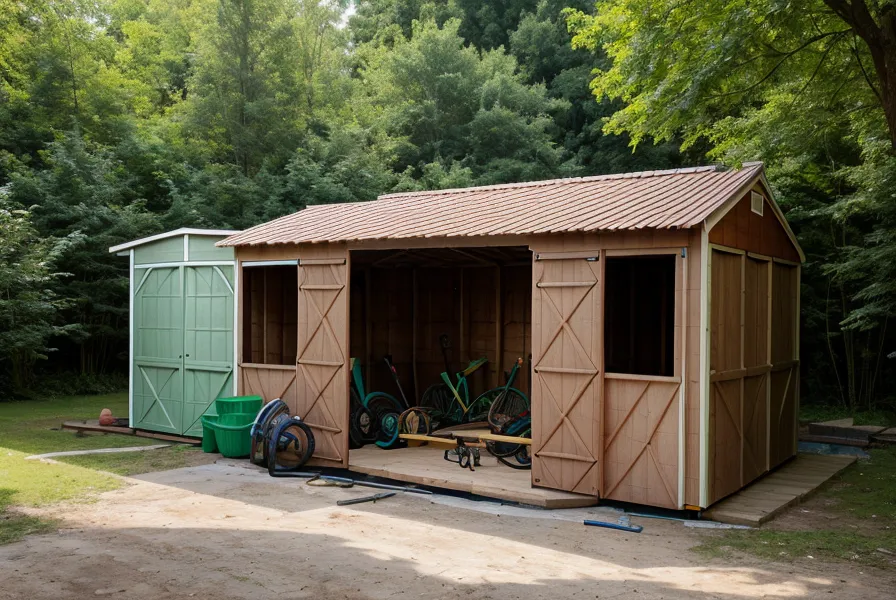
So Which One Would We Actually Pick Again?
Curing took a lot longer than either of us wanted to admit, and we made ourselves wait well past the point the slab looked and felt ready before we let anything heavy near it. That patience is the part nobody enjoys, bagged mix or ready-mix truck, and it's the same lesson we picked up building a simple garden bench — the finished part always outlasts the part where you're allowed to touch it.
So here's where we landed. Choose bagged concrete you mix yourself when the slab is small enough that a few strong backs can beat the clock, when your driveway or yard access can't handle a loaded truck, or when you want total control over the pour even if it means picking up extra bags halfway through. Choose a ready-mix truck when the slab is big enough that hand-mixing would eat your whole weekend, when your site can handle the weight and the access, and when your schedule can bend around theirs instead of the other way around. If you're still working out whether to build it yourself or call a contractor for the next backyard project, that same math applies — just add a lot more zeros to what you're weighing.