We almost built our very first raised bed a full inch too narrow because I marched into the lumber aisle, grabbed a stack of "2x4s," and assumed — like a reasonable person — that a 2x4 measures 2 inches by 4 inches. It does not. It measures 1 1/2 by 3 1/2 inches, and nobody at the register mentioned that until my other half started ripping boards to fit and the math stopped working halfway through the cut list. That's the whole scam behind "nominal" versus "actual" lumber sizing: nominal is the name printed on the tag, actual is what your tape measure says once you get the board home. It's a lot like ordering a "large" coffee that shows up in a cup clearly sized for a medium — the label and the contents are having two different conversations.
For a while we kept a cheat sheet on a phone — a screenshotted forum post, half the numbers cropped off the edge of the screen — and it failed us at the worst possible moment, standing in the lumber aisle with a full cart and zero signal. So this chart exists instead, and it's the one we actually keep bookmarked now.
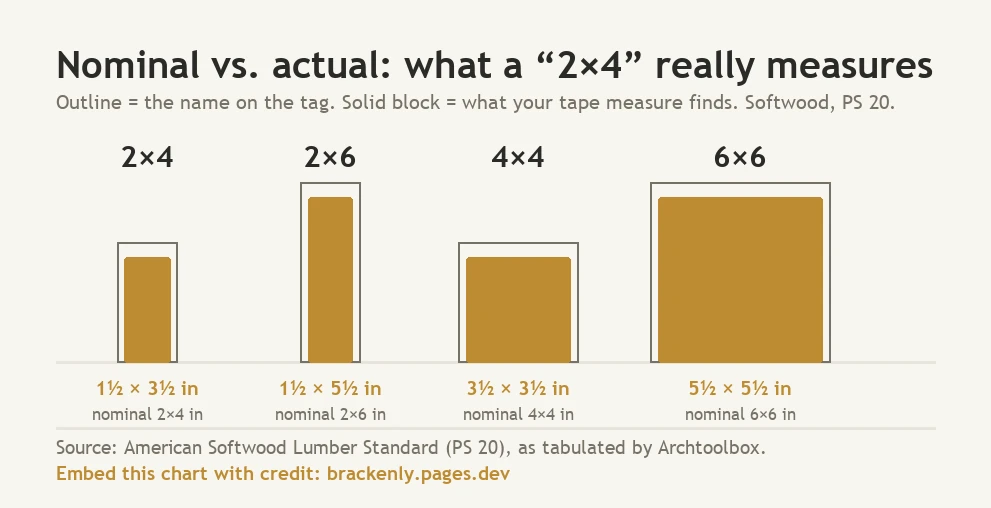
The one rule to remember: a "2×4" is not 2 by 4 inches — it's 1½ × 3½. Once a softwood board is dried and planed it finishes smaller than its nominal name (a 2-inch face loses a half-inch; a 1-inch board loses a quarter), so the tag is a nickname, not a measurement. Read the chart, not the tag.
Standard Softwood Dimensions (Dimensional Lumber)
Framing lumber — pine, fir, spruce, whatever the yard happens to have stacked highest — gets sold as "dimensional lumber," and the table below is the industry-standard shrinkage from rough-cut to dried-and-planed. I still pull this up before every materials list. Guessing wrong here is how you end up a whole board short on a Saturday afternoon with the store closing in twenty minutes.
| Nominal Size (Inches) | Actual Size (Inches) | Actual Size (Metric - mm) |
|---|---|---|
| 1 x 2 | 3/4 x 1 1/2 | 19 x 38 |
| 1 x 3 | 3/4 x 2 1/2 | 19 x 64 |
| 1 x 4 | 3/4 x 3 1/2 | 19 x 89 |
| 1 x 6 | 3/4 x 5 1/2 | 19 x 140 |
| 1 x 8 | 3/4 x 7 1/4 | 19 x 184 |
| 1 x 10 | 3/4 x 9 1/4 | 19 x 235 |
| 1 x 12 | 3/4 x 11 1/4 | 19 x 286 |
| 2 x 2 | 1 1/2 x 1 1/2 | 38 x 38 |
| 2 x 3 | 1 1/2 x 2 1/2 | 38 x 64 |
| 2 x 4 | 1 1/2 x 3 1/2 | 38 x 89 |
| 2 x 6 | 1 1/2 x 5 1/2 | 38 x 140 |
| 2 x 8 | 1 1/2 x 7 1/4 | 38 x 184 |
| 2 x 10 | 1 1/2 x 9 1/4 | 38 x 235 |
| 2 x 12 | 1 1/2 x 11 1/4 | 38 x 286 |
| 4 x 4 | 3 1/2 x 3 1/2 | 89 x 89 |
| 4 x 6 | 3 1/2 x 5 1/2 | 89 x 140 |
| 6 x 6 | 5 1/2 x 5 1/2 | 140 x 140 |
Source: American Softwood Lumber Standard (PS 20), as tabulated by Archtoolbox.
Hardwood Lumber Sizing (The Quarter System)
Hardwood — oak, maple, walnut, the stuff that ends up in furniture and the occasional over-ambitious garden gate — plays by different rules. It's sold in "quarters," where each quarter just means a quarter-inch of rough thickness before anybody planes it smooth. So a "4/4" board starts life at about an inch thick rough, and an "8/4" board starts at about two inches. We learned this on a potting bench build, ordering 4/4 oak expecting something close to furniture-flat stock and getting a rougher, thicker slab that ate way more sanding time than we'd budgeted for the weekend.
| Nominal Thickness (Quarters) | Rough Thickness (Inches) | Surfaced Thickness (S2S) |
|---|---|---|
| 4/4 | 1" | 13/16" |
| 5/4 | 1 1/4" | 1 1/16" |
| 6/4 | 1 1/2" | 1 5/16" |
| 8/4 | 2" | 1 3/4" |
| 12/4 | 3" | 2 3/4" |
Source: Archtoolbox's hardwood dimensions table (surfaced-two-sides figures). We dropped the 10/4 row entirely rather than repeat a number we couldn't re-verify anywhere — if your supplier quotes 10/4, ask them directly for the surfaced thickness.
Standard Lengths and Tolerances
Length is the one spec that actually holds steady — a board tagged 8 feet is going to be at least 8 feet, full stop. It might sneak a little longer, since mills get some wiggle room on the long side and none at all on the short side, which, if you think about it, is the exact opposite of how every road trip we've ever planned has gone.
| Length (Feet) | Length (Inches) | Length (Meters) |
|---|---|---|
| 6 feet | 72 inches | 1.829 meters |
| 8 feet | 96 inches | 2.438 meters |
| 10 feet | 120 inches | 3.048 meters |
| 12 feet | 144 inches | 3.658 meters |
| 14 feet | 168 inches | 4.267 meters |
| 16 feet | 192 inches | 4.877 meters |
| 18 feet | 216 inches | 5.486 meters |
| 20 feet | 240 inches | 6.096 meters |
| 22 feet | 264 inches | 6.706 meters |
| 24 feet | 288 inches | 7.315 meters |
Actual length must be at least the nominal length, with up to 3 inches of over-length allowed and none on the short side. Source: Archtoolbox, citing NIST Publication PS 20.
Historical Context of Lumber Standardization
So why the gap between the name on the tag and the board in your hands? It's a hundred-year-old holdover. Nearly a century ago, a "2x4" really was cut close to 2 by 4 inches — a rough, green piece straight off the saw. But by the time those boards were dried and planed smooth, they'd shrunk toward the 1½ × 3½ we know today, and the old nominal name just... stuck. That gap is still exactly what trips people up in the lumber aisle. It got contentious enough that, a few years back, consumer groups actually sued several big-box stores and hardware chains over it, arguing the lumber was flat-out undersized for what the tag claimed. We would have paid good money to watch that hearing. Bring receipts, bring a tape measure. (Source: Southern Pine Inspection Bureau.)
- ~100 years ago: a "2×4" was cut as a rough, green board close to a full 2 by 4 inches.
- After drying & planing: those boards shrank toward today's 1½ × 3½ — and the smaller finished size became the standard.
- Today: the tag still says "2×4"; your tape measure still says 1½ × 3½. That gap is what trips people up in the aisle.
- Recently: consumer groups sued several big-box and hardware chains, arguing the lumber was undersized for what the label claimed.
Last verified: 2026-08-12