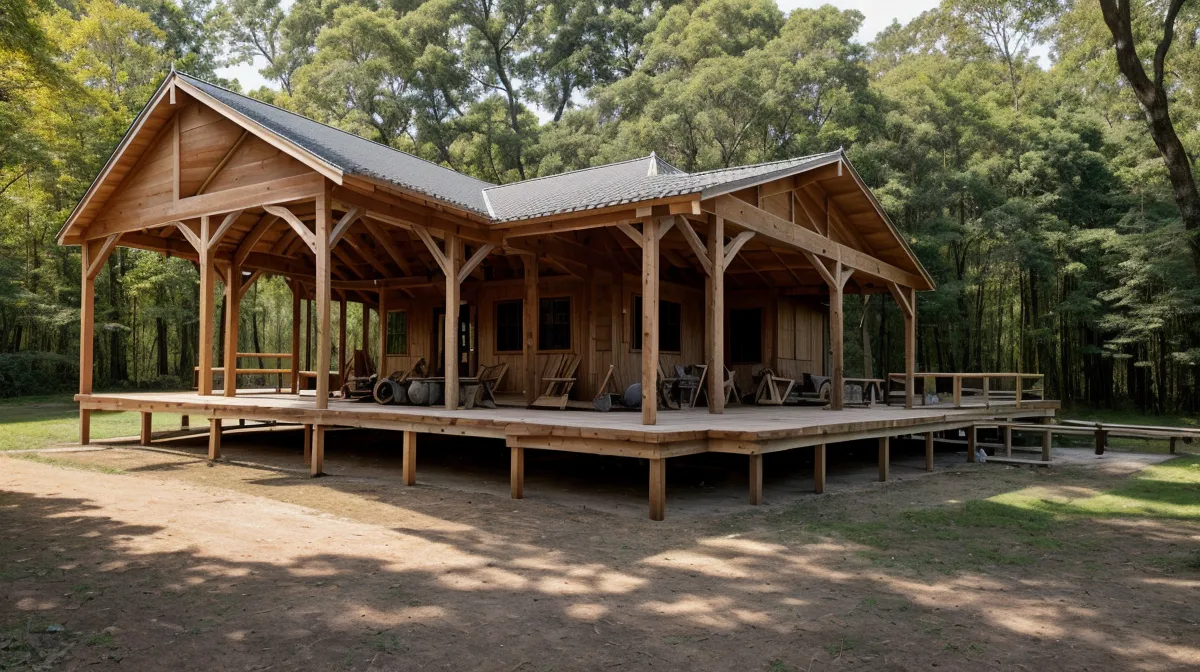
Our first shed still leans a half-inch toward the back fence, and we built it that way completely by accident. That's basically the origin story of this whole half-acre backyard DIY project: we bought a fixer-upper on the edge of a small Piedmont town, found out a contractor would charge more than we could stomach for basic outdoor construction, and decided to figure it out ourselves instead. It was either learn fast or spend the next decade living around unfinished projects.
Quick note before we get into it: this post has affiliate links in it. If you click through and buy plans, we get a small commission at no extra cost to you — that's part of how we keep this site running while we keep building. We only link to things we've actually bought and used on our own half-acre. If you want to jump straight to the resource that got us moving in the first place, TedsWoodworking is where we started.
We Built Our First Shed Without a Single Plan
She says: I'm the one who wants a spreadsheet before we touch a single board. He's more of a "point the level at it and hope" builder. So naturally, the very first thing we built — a plain storage shed — started with zero plans and a pile of lumber picked mostly on vibes.
He says: A shed's just a box, right? Wrong. I spent an entire Saturday relearning that a "two-by-four" isn't actually two inches by four inches; it's closer to an inch and a half by three and a half once it's milled, and that gap throws off every measurement down the line if you're not accounting for it. Add a roof pitch I was calculating on the fly, and by Sunday the whole thing racked sideways because we hadn't put in a single diagonal brace to keep it square. It leaned. It leaned a LOT.
Nothing about that shed was level, plumb, or square, and we didn't fully appreciate at the time that those three things are basically non-negotiable for anything meant to stand up straight for more than a season. We also learned that not every pressure-treated board is created equal. He grabbed the cheapest four-by-fours off the shelf at the big box store for the corner posts, and by the end of that first summer they'd bowed into shapes that looked more like bananas than lumber.
We'd already written up the specific outdoor building mistakes that cost us real money, including screws rusting orange within a season because nobody told us fasteners rated for outdoor use actually mattered, and realized professional plans were the only way to stop bleeding money on lumber. That's when we found TedsWoodworking and the Self Sufficient Backyard guide.
TedsWoodworking's Library of Woodworking Plans
She says: Opening TedsWoodworking for the first time was a little overwhelming: we're talking about a database of more than 16,000 plans, everything from gazebos to dog houses to full-size furniture. I spent one whole evening just scrolling through it. For someone who needs an actual cut list to feel confident picking up a saw, that library felt like finding a cheat code.
He says: The material lists were the real win for me. No more guessing how many boxes of deck screws to buy and driving back to the store twice in one afternoon. When we tackled the raised deck, I finally understood why a plan bothers to spell out post spacing and beam span instead of just saying "use a 4x4": get that spacing wrong and the deck bounces underfoot even if every board looks fine. Even something specific, like a freestanding deck that isn't attached to the house, has its own version in that library, which matters because a floating deck handles our clay soil completely differently than one bolted to the foundation.
We also looked at My Shed Plans, which has around 12,000 designs built specifically for outbuildings. It's a solid, focused tool if sheds and workshops are genuinely all you're building. But TedsWoodworking felt more like a membership to an entire woodworking club, useful whether we wanted a birdhouse on Monday or an entire workshop the following weekend, which, for the record, is still not finished.
Mapping Homesteading Projects With Self Sufficient Backyard
She says: TedsWoodworking is great for structures, but we wanted our half-acre to actually produce something, not just look tidy. That's where Self Sufficient Backyard came in. It isn't a blueprint library; it's more of a lifestyle manual, covering things like where to position a coop so the smell doesn't drift toward the porch, or how to set up basic water collection off a roofline.
He says: It's the difference between building a box and building a system. TedsWoodworking will tell you exactly how to frame a coop down to the hinges; Self Sufficient Backyard tells you why that coop needs hardware cloth buried into the ground around the run, not just chicken wire, if you want to keep predators out overnight. NC clay doesn't drain the way you'd hope, either, so a good chunk of our layout decisions ended up being about where water actually goes after a storm rather than where things looked prettiest on paper. We mapped the whole thing, coop and garden beds and a small off-grid solar setup for the far corner where running a power trench wasn't worth it, sitting on the porch with sweet tea instead of a hammer in hand.
By week twelve of running the yard the way the book laid out, the cold frame still had its lid cracked open after a hard February frost, and the seedlings inside hadn't so much as wilted; proof the layout decisions were paying off as much as the carpentry ever did.
She says: It helped with the "why" as much as the "how." Building a cover for our raised garden bed wasn't just a carpentry problem; it was about protecting a harvest that mattered enough that we drove out to the Pittsboro Farmers Market in Chatham County that same week just to see how other people were solving the same cover problem, and half the stalls there had some version of a homemade row cover rigged up already. Self Sufficient Backyard focuses on that long-term payoff in a way a standard woodworking plan just isn't built to do. Our friend Patrice, who pulled us into the neighborhood homesteaders group on Facebook, keeps a running spreadsheet of every dollar she's put into her own raised beds; we've never had that kind of patience, but watching her track it made us take our own layout more seriously.
Where Outdoor Construction Gets Complicated
After a year of trial and error, the tradeoff between these two resources got pretty clear. Want one specific, well-built project, like a pergola that can survive a real Piedmont thunderstorm? TedsWoodworking is the one to lean on. With that many plans in one place, you'll find something that matches your skill level and the look you're going for, beam span already calculated. It's built around the individual project, not the whole yard.
Self Sufficient Backyard is the better guide if you're thinking about the whole lot at once and want to squeeze food, water, or energy out of every square foot of it. It won't hand you a blueprint for a fine cabinet or a perfectly spec'd pergola, but it will walk you through something like a root cellar that actually holds its temperature.
He says: I'll admit the TedsWoodworking plans mostly assume you're building on ground that's already level, which around here is close to a fantasy. I had to learn about footings that go below the frost line (which shifts depending on the county) and about using lumber rated for actual ground contact instead of just "pressure-treated," to make those tidy plans work on our not-so-tidy lot. Some counties also want a permit once a deck crosses a certain size or height, which caught us off guard the first time; worth checking before you start digging, not after. Having 16,000 plans on hand at least meant I could compare three different deck designs until I found one that matched our slope instead of fighting it.
Small thing, but it mattered: we left a real gap between the deck boards instead of jamming them tight, because wood swells and shrinks with humidity here more than either of us expected the first year; boards that fit snug in October had buckled by July.
Which One Should You Actually Buy?
Last weekend we finally sat out on the deck, still square and still not wobbling, and looked over at the coop, which has kept every fox in the county on the wrong side of the fence for a good while now. Neither project would have turned out the same without both guides, just for different reasons.
Reach for TedsWoodworking if you want to build a specific structure or piece of outdoor furniture and need an exact cut list, so you're not standing in a checkout line a fourth time buying lumber you should have grabbed the first trip. Reach for Self Sufficient Backyard if the goal is less "build this one thing" and more "make this yard produce food, water, or energy for us." And if sheds and outbuildings are genuinely the only thing on your list, My Shed Plans is the narrower, cheaper way in.
She says: If your backyard currently looks like ours did that first fall, more mud pit than yard, start with TedsWoodworking. With that many plans on tap, you can start small, a planter box or a birdhouse, and work up to the bigger builds as your confidence and your tool collection both grow.
He says: The one thing I'd tell anyone starting out: buy the actual plan before you buy the lumber, every single time. It sounds obvious written down. It was not obvious to us, standing in a lumber aisle with a tape measure and way too much confidence. That's the whole lesson: the plan is cheaper than the mistake ever is.
Our workshop out past the garden is still nowhere near finished, two sides framed in OSB and a tarp doing the job a wall should on the third, but it's proof we're still building, not that we ever stopped learning how.
| Product | Rating | |
|---|---|---|
| TedsWoodworking Top Pick | 9.2 | Read More → |
| My Shed Plans | 8.8 | Read More → |
| Self Sufficient Backyard | 8.5 | Read More → |
TedsWoodworking
Pros
- ✓ Massive library of 16,000+ plans for every skill level
- ✓ Detailed cut lists saved us hundreds in wasted lumber
- ✓ Step-by-step instructions that even we couldn't mess up
- ✓ Includes everything from tiny crafts to full-sized decks
Cons
- ✗ Finding the perfect plan takes a bit of digital digging
- ✗ Some complex plans require advanced shop tools